 Naa Songs
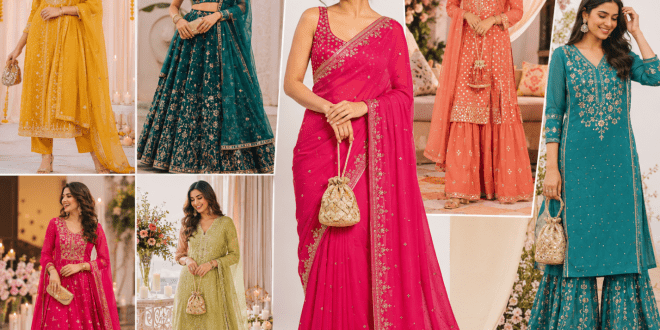
Every Indian wedding season brings the same quiet panic: the invitation arrives, the functions stack up, and suddenly you’re standing in front of your wardrobe with absolutely no idea what to wear to which ceremony. The colour you picked for the Sangeet feels too heavy for the Haldi. The lehenga you saved for the Reception seems to be competing with everyone else’s. It’s a lot.
Bollywood stars have been navigating this exact problem on a very public stage for decades — and their choices, across actual wedding appearances and cinematic roles, have quietly become the most reliable reference point Indian fashion has. The good news is that their approach is far more structured than it looks on screen.
This guide breaks down the Bollywood wedding guest formula by function, pulls out the styling principles behind the looks, and gives you a framework you can actually reuse — not just for one wedding, but for every invitation that lands in your inbox.
Why Bollywood Wedding Guest Looks Are Worth Paying Attention To
Bollywood wedding looks are useful because they show how outfits change from one ceremony to another. A Haldi look is usually lighter and brighter, a Sangeet outfit can handle shine and movement, and the main ceremony often calls for richer colour and more formal construction.
Still, Bollywood should be treated as a reference point, not a rulebook. Real wedding dress codes vary by region, family, venue, and season. The goal is not to copy a celebrity look exactly, but to borrow the logic behind it: match the outfit to the function, the lighting, and the amount of movement the event requires.
Bollywood Wedding Guest Outfit Ideas by Function
Indian weddings are not one event. They are a sequence of ceremonies, each with its own energy, formality level, and unspoken dress code. The most common mistake wedding guests make is treating all functions as interchangeable. Bollywood does not make that mistake.
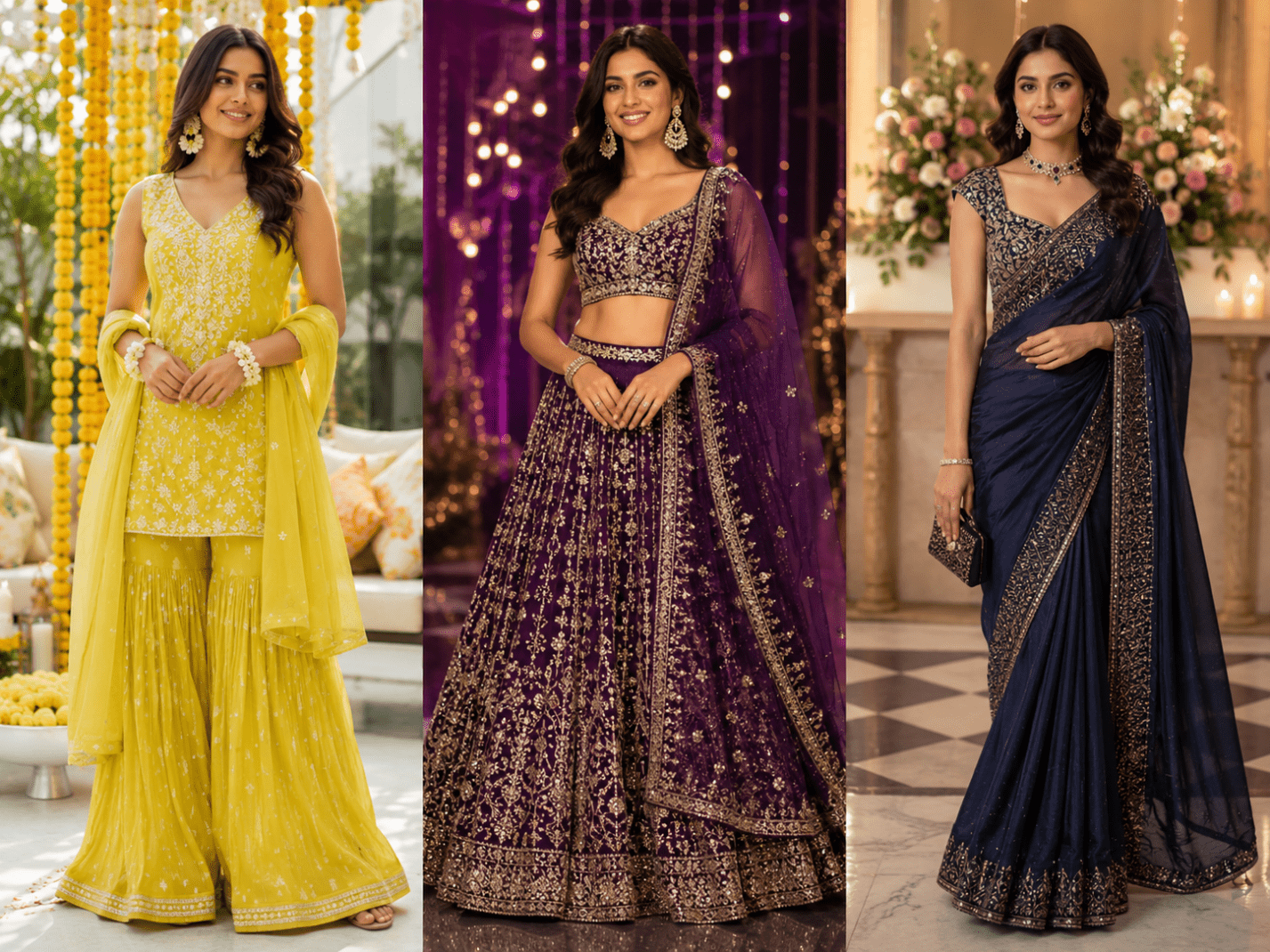
Haldi and Mehndi — Go Bright, Go Easy
The logic is practical as much as aesthetic. You may be moving freely, sitting on the floor, or spending hours in warm weather, so heavy layers and stiff construction work against the mood of the function. This is where fabric choice matters most: lighter ethnic separates and Haldi-appropriate outfits often use soft breathable cotton and similar natural weaves as the base, keeping the silhouette relaxed without making the colour feel less festive.
Colour palette: yellows, mustards, greens, and oranges. Keep embellishment minimal — mirror work or simple embroidery rather than heavy zari. Footwear should be comfortable enough for grass or uneven outdoor surfaces.
Sangeet Night — Where Sequins Are Not Optional
The Sangeet is the function where Bollywood’s aesthetic instincts are most fully unleashed — and for good reason. It is an evening event, usually held indoors under warm or coloured lighting, and centred on music and dance. The visual atmosphere supports a level of embellishment that would feel excessive at any other point in the wedding calendar.
The celebrity references worth studying here include Kareena Kapoor’s mirror-work lehengas, Deepika Padukone’s heavily sequined floor-length gowns, and Katrina Kaif’s metallic sarees. What these looks share is a deliberate engagement with the lighting environment — they are designed to catch and reflect light in motion, which is exactly what a dance floor demands.
Practically: choose garments with sequin work, foil prints, or metallic thread embroidery. A floor-sweeping lehenga is the strongest Bollywood-approved choice for this function, but a heavily embellished saree or a contemporary structured gown with metallic detail works equally well. Avoid matte fabrics and very pale colours — they tend to disappear under Sangeet lighting rather than shine.
Baraat and Wedding Ceremony — Silk-Level Formality
The main wedding ceremony is where formality peaks. Bollywood has a clear consensus on this: rich, structured silhouettes in jewel tones or classic bridal-adjacent colours. The recurring motifs across film wedding scenes and real celebrity wedding appearances are heavy silk sarees, fully worked lehengas in deep reds, burgundies, forest greens, and navy, and occasionally a sharply tailored Anarkali suit with significant embroidery.
The key distinction at this function is that the fabric should feel substantive. Lightweight or casual materials read as underdressed against the formality of the ceremony. The textures Bollywood returns to here — brocade, silk, heavy georgette with zari work — all communicate occasion-level dressing.
One practical note on colour: check the couple’s family customs before choosing white, ivory, or a shade close to bridal red. In many wedding settings, these colours carry specific meanings or may overlap with the bride’s look. Deep coral, burnt orange, wine, emerald, and navy usually give the same richness with less risk of looking bridal.
Reception — Your Most Fashion-Forward Moment
The Reception is the Bollywood moment where Indo-western fusion consistently appears. This is the function where Kiara Advani’s structured jumpsuits, Sonam Kapoor’s draped gown experiments, and Janhvi Kapoor’s contemporary lehenga variations get referenced most frequently — because the Reception tends to be the most relaxed in terms of traditional dress code expectations.
This is the space to bring in cleaner silhouettes, sharper tailoring, and lighter embellishment. A well-cut anarkali in a solid deep colour, a pre-draped saree in a contemporary drape style, or even a Western-influenced evening gown with Indian accessories all work here. The formality remains high, but the register shifts from traditional-heavy toward modern-elegant.
The styling principle that emerges from observing Bollywood Reception looks across recent years: one strong element per outfit. Either the garment is the statement and the accessories are minimal, or the accessories do the heavy lifting and the garment is clean and structured. The looks that fail at this function are typically the ones trying to do both simultaneously.
Three Bollywood Styling Rules That Change Everything
Beyond the function-specific breakdown, there are recurring principles across Bollywood wedding fashion that are worth internalising — because they apply regardless of which ceremony you are attending.
Colour before silhouette. In every Bollywood wedding look that works, the colour decision was made first. The silhouette and embellishment level were chosen to serve that colour, not the other way around. This reverses how most people approach outfit planning, but it produces far more cohesive results. Choose the colour that suits the function’s energy and your complexion, then find the right form to carry it.
Accessory subtraction. The most photographed Bollywood wedding looks are almost universally edited. Kareena’s Diwali appearances demonstrate this consistently: statement earrings and nothing else. Or a strong necklace with plain studs. The instinct to layer jewellery at Indian weddings is understandable, but Bollywood’s actual red-carpet and wedding appearance choices demonstrate that restraint photographs better and reads as more considered.
Comfort determines posture. This is perhaps the most practically useful observation. An outfit that restricts movement or requires constant readjustment will affect how you carry yourself through six hours of ceremonies, sitting, standing, and dancing. If the garment requires you to think about it every few minutes, it is not the right choice for this context, no matter how good it looks in a still photograph.
The way a garment moves and breathes over the course of a long celebration comes down to how it was made. Finding pieces constructed from the right materials — or sourcing fabric by the yard if you are having something custom-stitched — is the step that separates an outfit that holds up across an entire wedding day from one that starts to fight you by the evening ceremonies.
The Bollywood Wedding Guest Outfit Formula You Can Actually Use
What makes Bollywood’s approach to wedding guest dressing genuinely transferable is that it is not based on replicating specific looks. It is based on a set of decisions made in a specific order.
Start with the function and its timing. Daytime outdoor ceremonies call for natural fabrics, bright colours, and easy movement. Evening indoor events support embellishment, structured silhouettes, and richer fabric weights. The ceremony-to-reception arc moves from traditional-formal to modern-elegant.
Then choose your colour anchor. Match the energy of the function rather than trying to avoid standing out — Indian weddings are designed for colour, and a well-chosen festive tone is always appropriate. The cautions are around white and bridal red; everything else is fair territory.
Then decide on your embellishment level, working from the colour and the occasion. Heavy embroidery and sequin work belong at evening functions highlighting drama. Lighter mirror work and simple block print belong at daytime functions. The fabric itself determines whether the embellishment lands or overwhelms.
Finally, plan your accessories as a counterweight to the garment, not an addition to it. If the outfit is detailed, the accessories should be clean. If the garment is simple, one strong piece of jewellery carries the whole look.
This four-part decision sequence — occasion, colour, embellishment level, accessories — is what Bollywood stars actually apply, even when the results look effortlessly spontaneous. It works because it makes each decision in the right order, so nothing conflicts. Apply it to the next wedding invitation on your calendar, and the wardrobe panic should start to quiet down considerably.
Indian weddings are some of the most visually abundant celebrations in the world, and showing up dressed well for each function is a genuine act of care — for the couple, for the occasion, and for yourself. Bollywood has spent decades working out what that looks like in practice. The framework is there. You just have to know which part of it to borrow.