 Naa Songs
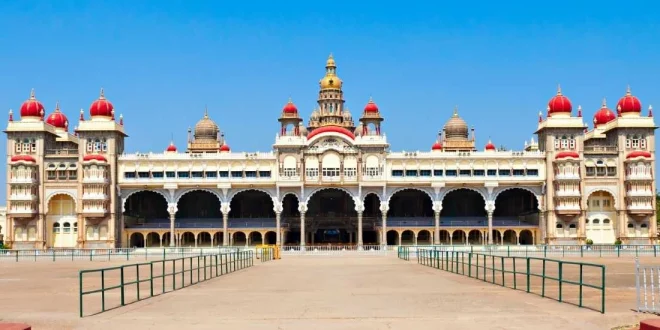
Mysore, officially known as Mysuru, is a city where history is subtly present in the marketplaces, palaces, and common streets. Formerly the Wodeyar dynasty’s seat, it offers a rich cultural experience that goes much beyond conventional tourism. Grand monuments generate a rhythm that makes heritage seem less unique and more ingrained in daily life by blending in with surrounding places.
For those who are interested in history, Mysore feels less like a place to visit and more like a story that is being moulded by living customs, scholarship, royalty, and colonial contacts. Tales of the past may be heard around every turn, enticing tourists to take their time, pay close attention, and participate in tales that have been passed down through the ages.
Discover Mysore Palace and Its Royal Echo
A trip to Mysore wouldn’t be complete without visiting its highest point. Mysore Palace, with its elaborately decorated interiors, is the pinnacle of Indo-Saracenic architecture and a striking reminder of a great past. Grand durbar halls, elaborately carved doors, and stained-glass ceilings all whisper stories of ceremonial grandeur as one descends.
Go in the evening when it is aglow with warm lights. The soft illumination makes the architecture shimmer and gives away a sense of majesty that doesn’t require a guidebook to feel.
Spend Time at Jaganmohan Palace Art Gallery
Jaganmohan Palace has a more subdued thread of Mysore’s culture. It used to be a royal residence but is now home to a large collection of artworks, including Raja Ravi Varma pieces dating from classical murals to artifacts from other ages.
The gallery encourages leisurely exploring. From colonial-era portraiture to traditional Indian styles, each space exhibits shifting artistic influences.
Walk Through Devaraja Market
Devaraja Market offers a kaleidoscopic lens to touch the everyday heritage of Mysore’s living past. Established in the era of Tipu Sultan, the market remains largely unchanged in spirit. You can expect aromatic piles of jasmine, rows of kumkum, and brassware stalls-all hinting at a sensory archive of the city’s commercial heartbeat. It is an ideal place to see how everyday commerce perpetuates history.
Climb Chamundi Hill for Spiritual Context
Chamundi Hill adds a spiritual aspect to Mysore’s illustrious past. On top of the hill, the Chamundeshwari Temple has always been a key element of Mysore’s identity, deeply revered by the Wodeyars, the royal family.
While the temple complex offers historical background on Mysore’s mythological origins and royal patronage, the drive or climb affords expansive views.
Visit Tipu Sultan’s Summer Palace
A brief detour from the city center leads to Tipu Sultan’s Summer Palace in Srirangapatna. This building, which is entirely constructed of teak wood, is an example of Indo-Islamic architecture with military overtones.
There are murals inside that depict battles and courtly scenes. The palace helps to locate Mysore within the broader context of colonial resistance in South India.
Visit St Philomena’s Cathedral
The colonial era of Mysore is reflected in St. Philomena’s Cathedral. Its tall spires and stained-glass windows, which draw inspiration from Neo-Gothic design, demonstrate the influence of Europe during British administration.
The cathedral reminds tourists of Mysore’s many historical facets by contrasting with royal and temple architecture.
Explore the Rail Museum and Folklore Museum
The Rail Museum, which features antique locomotives and royal carriages, provides a less conventional look at Mysore’s transportation past. The Folklore Museum, which is close by, features rural items, traditional crafts, and costumes.
Collectively, they connect daily cultural behaviours with elite history.
Visit the Oriental Research Institute
Another worthwhile stop is the Oriental Research Institute, a hidden gem for anyone with an interest in academic history. It was founded in the late 1800s and has hundreds of old texts written on paper and palm leaves. These collections comprise early literary works, legal treatises, and philosophical writings.
The reading halls invite guests to contemplate the preservation of information in a serene and reflective setting. Even a quick tour of the reading halls reveals Mysore’s intellectual side, which goes unnoticed by the royal family.
The institute is often overlooked, but it is a refreshing perspective on intellectual history and adds depth to palace tours. The institute is a place of quiet, almost ceremonial in its own way.
Attend a Classical Music or Dance Performance
Mysore has been home to Carnatic music and Bharatanatyam since generations. Many local theaters and cultural centers often conduct shows in the evenings.
Attending one gives you the opportunity to encounter living heritage instead of preserved artefacts, which enhances your comprehension of the past on an emotional level.
Take a Heritage Walk Around the Old City
Guided heritage walks cover Lashkar Mohalla and Mandi Mohalla, exploring colonial bungalows, old mosques, and heritage homes. These walks could also help put into perspective the development of communities in relation to the system of royal governance.
Pause at Kukkarahalli Lake
This lake was once a hangout for royals and scholars, but it is now a peaceful haven of calm away from all the grand monuments. Walking around this spot encourages you to let the history of the city sink in, especially during early mornings.
Where to Take a Break Between Explorations
With all the grand palace visits and relaxed museum days, sometimes it is the small things like behind the scenes, logistics – that are actually much more crucial to the travel experience than one might care to admit. And Mysore’s got it all – ranging from heritage properties to simpler, more contemporary options, depending on what kind of experience you’re seeking. Looking through, you might even find hotels in Mysore tucked into convenient neighbourhoods that work quite well as bases for a day of history.
The hotel booking treebo app proves useful when curiosity reshapes your day, turning quick stops into extended explorations. It allows travelers to be more flexible, which is a good thing because a museum experience can extend beyond an allotted amount of time, or perhaps an available heritage walk can extend longer than expected.
Conclusion
Mysore is a city that rewards the slow traveler. Cultural experience is not about ticking boxes; it’s about feeling the connection that binds the past to the present. From lavish royal palaces to thriving bazaars, Mysore is about living history, not museum-izing it. Each street, temple, and art space adds another dimension to Mysore’s ongoing narrative.
History buffs will enjoy Mysore in slow motion, allowing time to observe quietly as you walk around. Mysore reveals itself in its architecture, in its art, in its daily life in a way that flows quietly. Listen carefully, and Mysore will tell you its story, one slow moment at a time.


