 Naa Songs
Infrastructure pipe joints are often judged by what happens after installation: whether they remain sealed under pressure, tolerate temperature changes, and withstand years of service. Yet the reliability of an electrofusion fitting or injection-moulded valve body begins much earlier, with the polymer compound and the way its ingredients are processed.
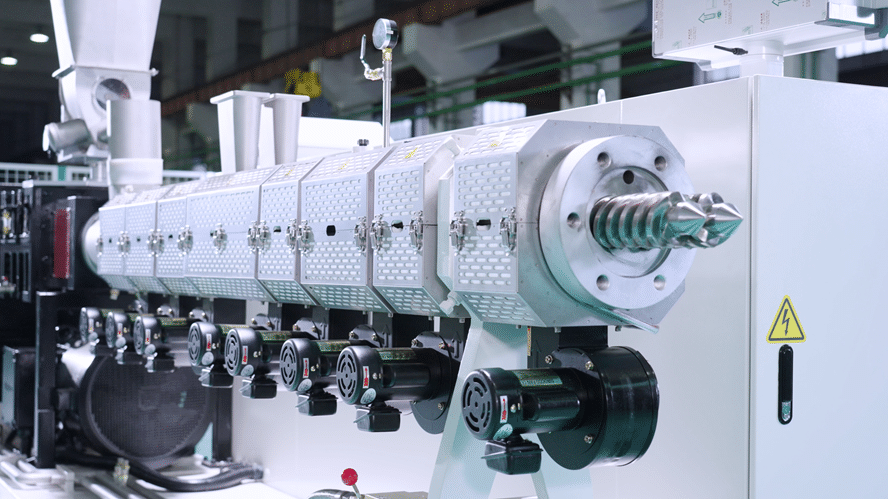
During compounding, twin screw extrusion machines combine resin, stabilizers, pigments and other formulation ingredients to form a uniform melt. For infrastructure fittings, control over melt flow rate (MFR), dispersion, and thermal history matters because small variations in compound behavior can affect mould filling, fusion performance, and the integrity of pipe connections.
MFR Control for Electrofusion Fitting Compounds
Electrofusion fittings connect compatible thermoplastic pipes through an embedded resistance wire that heats the joint interface. As the polymer surfaces soften and fuse, the fitting and pipe must form a stable joint under the specified installation conditions. The compound used in the fitting consequently needs predictable processing behavior and suitable mechanical properties. MFR is one useful indicator of how a thermoplastic flows under a defined temperature and load, allowing processors to monitor material consistency between batches.
A target MFR range helps maintain repeatability, but the number alone cannot describe the full performance of a fitting compound. Two materials with similar MFR values may differ in molecular structure, additives, or long-term resistance to slow crack growth. Resin selection and formulation must therefore reflect the fitting’s intended pressure rating, joining method, and applicable product standards. Testing should combine flow measurements with mechanical and application-specific evaluations rather than treating a single laboratory result as a complete assessment.
Compounding conditions influence the uniformity of the material being tested. Uneven feeding, inconsistent melt temperature, or poor additive dispersion can produce local differences in composition and flow behavior. A twin screw extruder offers intermeshing screw elements and controlled feeding options that can help distribute ingredients through the polymer melt. Screw configuration, speed, throughput, and residence time need to suit the formulation; excessive heat or shear can damage sensitive ingredients, while inadequate mixing may leave the compound less uniform than required.
Injection Moulding Performance in Valve Bodies
Valve bodies used in water and utility infrastructure must retain their shape while accommodating internal pressure, mechanical loads, and repeated operation. Their geometry may include thick sections, narrow flow paths, threaded areas, and complex transitions. During injection moulding, the compound must fill these regions without excessive short shots, weld-line weakness, or dimensional variation. A consistent feedstock makes it easier to establish stable moulding conditions and maintain repeatable part quality.
MFR influences how readily the melt travels through the mould, but higher flow is not automatically better. Excessively high flow may be associated with a material structure that does not provide the required balance of strength and toughness, depending on resin grade and formulation. Conversely, a compound with insufficient flow under the selected processing conditions can increase filling pressure or leave remote sections inadequately filled. Mould design, gate location, melt temperature, holding pressure, and cooling must be evaluated alongside material properties.
The compounding stage can affect downstream moulding stability through dispersion and thermal history. Inconsistent pigment or stabilizer distribution may produce visible variation, while contamination or degradation can impair mechanical performance. Material handling also matters: storage conditions and moisture control should follow the requirements of the specific polymer formulation. Routine checks of MFR, density where relevant, appearance, and mechanical properties can help identify deviations before they translate into a larger number of rejected moulded components.
Compound Consistency and Electrofusion Joint Quality
The performance of an electrofusion joint depends on several interacting factors, including pipe and fitting compatibility, surface preparation, alignment, heating-cycle control, and cooling time. Compound quality is one part of this system. If the fitting material varies significantly in composition or thermal response, its behavior during heating and fusion may become less predictable. Even so, a consistent compound cannot compensate for contaminated pipe surfaces, incorrect installation parameters, or unsuitable joining procedures.
Reliable production begins with traceable raw materials and controlled ingredient dosing. Resin batches should meet the formulation’s requirements, while stabilizers and other additives need accurate proportions and thorough dispersion. Production monitoring can track temperature zones, screw speed, feed rate, torque, and melt pressure to identify changes that may affect the compound. Laboratory testing then checks whether the resulting material remains within its specified processing and performance ranges.
DEKUMA describes its DKM-EII Twin-Screw Pipe Extruder as incorporating an AC/DC motor, an Italian-imported gearbox, a raw-material hopper with blender and twin-screw feeding, and an automatic control system with real-time data logging. Its nitrogen-treated alloy-steel barrel is designed for wear resistance, and the twin-screw assembly is specified for CPVC and UPVC formulations. Those stated material applications should not be assumed to cover every polyethylene electrofusion compound or valve-body formulation; equipment suitability must be confirmed against the target resin, MFR range, required output, and downstream processing needs.
Conclusion
Pipe fitting reliability is built through several connected stages, from formulation and compounding to moulding, joint preparation, and installation. MFR provides a useful checkpoint for material consistency, while dispersion and thermal control help reduce batch-to-batch variation.
A twin screw extrusion machine can support compound preparation when its configuration matches the formulation, and a twin screw extruder must be assessed against the intended resin and process window rather than equipment features alone. With its documented extrusion systems, DEKUMA offers a practical reference for industrial process control, while infrastructure fitting applications still require material-specific validation and testing of the finished components and joints.
